Zhuoyang Lyu
Zhuoyang Lyu

Zhuoyang Lyu

MMSc candidate in Biomedical Informatics · Harvard Medical School

I’m a master’s student in Biomedical Informatics at Harvard Medical School, working with Prof. Li Zhou at Brigham and Women’s Hospital. I’m broadly interested in machine learning for biology and medicine, and I’m applying to PhD programs for entry in Fall 2027.

About

I’m in the second year of the MMSc-BMI program at Harvard Medical School. Before this I was at Brown, where I finished an Sc.B. in Computer Science with Honors and an A.B. in Applied Mathematics.

I’ve worked across a fairly wide slice of machine learning for biology and medicine. The earlier work sat closer to the biology — single-cell and spatial transcriptomics, graph neural networks, wet-lab molecular data, and foundation models pretrained and post-trained on it. More recently much of the same machinery has gone to work on health and medical data: medical imaging, hospital records, agentic systems built on language models, and clinical software running in production.

What ties them together is less a single topic than where I want the work to end up. A model that performs well and a model that someone will actually act on are different things; in medicine especially, the distance between the two is what decides whether any of it matters. I’d like to spend my time closing that distance — on problems where getting it right changes what a clinician or a biologist can do. Several of these directions feel genuinely open to me, and I’d rather stay curious about which one to push hardest on than decide it prematurely. I’m happy to talk about any of them.

Current projects

Agentic clinical decision support for cognitive decline

2025–present

A multi-agent system for early detection of cognitive decline in primary care. It identifies dementia risk-factor information missing from the EHR, interviews the patient to fill those gaps, and returns a provider-ready summary with next-step recommendations. Built in Python and LangGraph — ReAct tool-calling agents, critic-in-the-loop quality assurance, and retrieval-augmented generation over clinical practice guidelines to keep the outputs grounded.

In physician evaluation across real patients it reached 99.9% F1 on identifying documented risk-factor gaps, and its next-step suggestions were rated 4.7 out of 5 for correctness and completeness.

My role: designed and implemented the full system. Co-first author; manuscript in final revision.

Multi-modal foundation model for melanoma prognostication

MMSc thesis · 2026–present

A generative foundation model of melanoma patient trajectories, trained jointly on institutional structured EHR data, clinical notes, and clinical genetic testing results. The central design decision was a custom clinical vocabulary that encodes a patient’s history as an event sequence, so a generative transformer can be trained over it directly.

My role: sole developer of the modeling work. First-author manuscript in preparation.

Multi-modal foundation model for ICU patient trajectories

2026–present

The same trajectory-modeling approach applied to critical care — acute hypoxemic respiratory failure and ARDS — where the event stream is hourly rather than episodic and carries ventilator settings and serial laboratory values alongside notes. Adapting the event vocabulary to high-frequency signals has been the interesting part.

My role: sole developer of the modeling work. Co-first-author manuscript in preparation.

Previously

  • C2S-Scale, single-cell foundation models — Yale, with David van Dijk. Post-training group: instruction tuning and RL from preferences. I contributed the scRNA-seq publication question-answering benchmark used for tuning and evaluation.
  • Collective migration in EMT cells with graph neural networks — Brown, with Ian Y. Wong. Senior honors thesis; sole author.
  • FIMP — Yale, with David van Dijk. Injecting pretrained foundation-model weights into GNN message passing, applied to single-cell and spatial transcriptomics.
  • RNA splicing state indicator — Brown, with William G. Fairbrother. A multi-exon reporter gene as a low-cost assay for a cell line’s splicing environment.
  • Medical imaging and biosignals — prostate cancer detection on MRI (PI-CAI, with Chen Sun at Brown), AAV capsid design at Edigene, and EEG-based mental workload classification.

Full detail in the CV.

Publications

Journal articles & conference proceedings

Single antisense oligonucleotides correct diverse splicing mutations in hotspot exons

Duan C, Rong S, Buerer L, Neil CR, Zhong Y, Lyu Z, Savatt JM, Strande NT, Fairbrother WG · PNAS · 2025

doi

LLE-STD: traffic sign detection based on low-light image enhancement and small target detection

Wang T, Qu H, Liu C, Zheng T, Lyu Z · Mathematics · 2024

doi

Identifying stable EEG patterns over time for mental workload recognition using a transfer DS-CNN framework

Jin L, Qu H, Pang L, Zhang Z, Lyu Z · Biomedical Signal Processing and Control · 2023

doi

A lightweight model for 3D point cloud object detection

Li Z, Li Y, Wang Y, Xie G, Qu H, Lyu Z · Applied Sciences · 2023

doi

Histopathological cancer detection: a comparison study of different convolutional neural networks

Lyu Z · Proc. SPIE 12259 (CAMMIC) · 2022 · sole author

doi

Research on subway pedestrian detection algorithm based on big data cleaning technology

Lyu Z · Wireless Communications and Mobile Computing · 2021 · sole author

doi

Preprints & manuscripts under review

Ultrasound vision–language alignment via contrastive learning

Lyu Z*, Zhang Y*, Wang T*, Lan R* · arXiv · 2026 · *equal contribution

arXiv:2605.02126

Linguistic effects of ambient AI on clinical documentation: a matched pre–post study

Li Y, Zhou H, Blackley S, Plasek JM, Lyu Z, Zhang W, You J, Centi A, Mishuris R, Yang J, Zhou L · medRxiv · 2026

medRxiv

Scaling large language models for next-generation single-cell analysis

Rizvi SA, Levine D, Patel A, Zhang S, Wang E, He S, Zhang D, Tang C, Lyu Z, et al. · bioRxiv · 2025

C2S-Scale. I contributed the scRNA-seq publication question-answering benchmark used for instruction tuning and evaluation.

doi

FIMP: Foundation model-informed message passing for graph neural networks

Rizvi SA, Pallikkavaliyaveetil N, Zhang D, Lyu Z, et al. · Under review, TMLR

arXiv:2210.09475

Conference presentations & posters

Understanding morphology and motility states in epithelial cells

Lyu Z · Brown University Summer Research Symposium · August 2024

poster

Deep learning-guided and structure-informed multifunctional AAV capsid design pipeline for manufacturability and redirected tropisms

Zhang C, Lv Z, Lu Z, Zhang Y, Yuan P · ASGCT 27th Annual Meeting, Baltimore · May 2024

Published abstract #970 in Molecular Therapy 32(4, Suppl. 1), 473.
Education

Harvard Medical School

2025–2027

Master of Medical Sciences in Biomedical Informatics · GPA 3.98

Advisor: Li Zhou

Brown University

2022–2025

Sc.B. Computer Science with Honors · A.B. Applied Mathematics · GPA 4.00

Honors thesis: “Predicting Collective Migration in EMT Cells with Graph Neural Networks” · Advisor: Ian Y. Wong

Purdue University

2021–2022

Computer Science and Mathematics; transferred to Brown

Awards

Magna cum laude, Brown University — top ~20% of the class2025
Honors in Computer Science, Brown University2025
Undergraduate Teaching & Research Award (UTRA), Brown University2024

What I work with

Foundation models
Pretraining and post-training of transformers; tokenizer and vocabulary design for non-text sequence data; instruction tuning; RL from preferences (DPO, PPO, GRPO); parameter-efficient fine-tuning; multi-modal and vision–language representation learning.
Agentic systems
Multi-agent orchestration, tool use and function calling, retrieval-augmented generation, cross-agent memory and state, guardrails and critic-based QA, evaluation and error analysis of agent behavior. LangGraph.
Modeling
Transformers, graph neural networks, convolutional and attention architectures; 3D medical image segmentation and detection (nnU-Net, nnDetection); classical ML and clustering; dimensionality reduction and signal decomposition (PCA, ICA, Fourier).
Biomedical data
EHR under IRB governance — structured records, clinical notes, genomics, clinical time series; single-cell and spatial transcriptomics; imaging across radiology, dermatology, and pathology.
Building and shipping
End-to-end from model training to a clinical application in production use; full-stack web (Java/Spring Boot, Vue, MySQL, Redis); implementing architectures and training loops from primitives rather than only from high-level libraries.
Languages and tools
Python, R, C/C++, SQL, Java, MATLAB. PyTorch, HuggingFace (Transformers, TRL, PEFT), TensorFlow/Keras, scikit-learn, NumPy, Git.

Off the clock

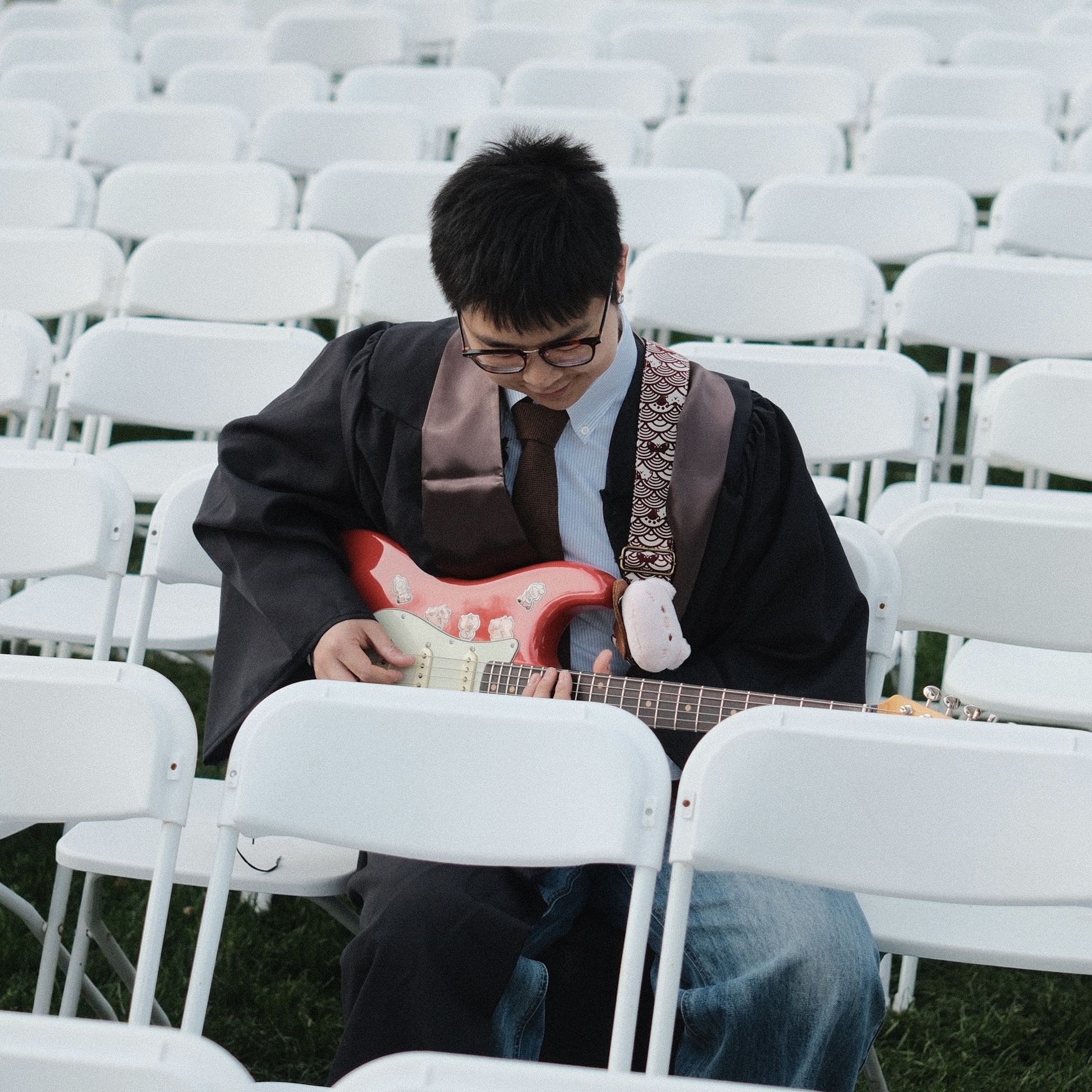
I play guitar and write my own songs. Rock and roll, mostly — the loud, guitar-first kind, and I’ll defend the position that the genre peaked before I was born and has been doing fine ever since anyway.

I was in a band in college, which taught me more about working with other people under a deadline than any group project did. Four people, one room, a set to play in two weeks, and no way to fake having practiced.

I still write on weekends, mostly for nobody in particular. It’s the only thing I do where the first draft being bad is the entire point, which turns out to be a useful thing to practice.

Contact

I’m applying to PhD programs for entry in Fall 2027. If you’re a prospective advisor, a student answering questions about a program, or someone who read one of these papers and wants to talk about it — please write. I answer everything.

zhuoyang_lyu@hms.harvard.edu